
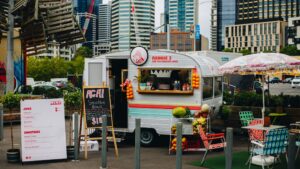
 Food trucks have become a major part of the culture in DTLA. From lunch crowds in the Financial District to late night stops in the Arts District, these mobile vendors bring convenience and energy to busy streets. At the same time, the way food trucks operate can create safety risks for both drivers and pedestrians.
Unlike traditional restaurants, food trucks are constantly moving and setting up in different locations. They often park along crowded streets, near office buildings, or in areas with high foot traffic. This creates a situation where vehicles and pedestrians are drawn to a single spot, increasing congestion and the likelihood of accidents.
One of the most common issues involves sudden stops. A food truck may pull over quickly when it finds an open space or a high demand location. Drivers behind the truck may not expect the stop, leading to rear end collisions. In busy downtown traffic, even a short delay in reaction time can cause a chain of events that results in multiple vehicles being involved.
Pedestrian activity around food trucks can also be unpredictable. People may cross the street mid block to reach a vendor or step into the roadway while looking at menus or placing orders. Lines often form on sidewalks and can spill into nearby streets, creating obstacles for both foot traffic and passing vehicles. Drivers may have difficulty seeing pedestrians who are partially blocked by the truck itself.
Visibility is a major concern in these situations. Food trucks are large and can obstruct sight lines at intersections or along narrow streets. A driver attempting to turn may not see a pedestrian walking around the truck. Similarly, someone stepping away from a food truck may not see an approaching vehicle until it is too late.
Another factor is the use of equipment. Food trucks often operate with generators, extension cords, and temporary setups that extend beyond the vehicle. These elements can create tripping hazards on sidewalks or force pedestrians to walk into the street to get around them. Spills or uneven surfaces near the truck can also increase the risk of slip and fall injuries.
Parking regulations and enforcement can play a role in these accidents as well. When food trucks park in areas that are not designed for vending, they may block traffic lanes, bike lanes, or crosswalks. This disrupts normal traffic patterns and creates confusion for drivers who are trying to navigate through already congested streets.
Rideshare and delivery drivers often add to the congestion around food trucks. A driver may stop nearby to pick up food or drop off a passenger, further limiting available space. With multiple vehicles stopping and starting in the same area, the risk of minor collisions and more serious accidents increases.
Time of day also matters. Lunch hours and late night periods tend to bring the highest levels of activity. During these times, drivers may be in a hurry, pedestrians may be less attentive, and the overall pace of movement can become chaotic. These conditions make it easier for accidents to happen.
Preventing these incidents requires awareness from everyone involved. Drivers should approach areas with visible food trucks cautiously and expect sudden stops or pedestrian movement. Slowing down and maintaining a safe distance from larger vehicles can help reduce the risk of collisions. Pedestrians should remain aware of traffic when approaching or leaving a food truck and avoid stepping into the street without checking for oncoming vehicles.
When accidents occur, determining responsibility can depend on several factors. The actions of the food truck operator, nearby drivers, and pedestrians may all be considered. In some cases, issues related to where the truck was parked or how it was operating can also affect liability.
Kamelia Jalilvand represents individuals who have been injured in a wide range of accident scenarios across Los Angeles, including those involving mobile vendors and congested urban environments. She understands how quickly a routine stop at a food truck can turn into a serious situation. By carefully reviewing the details of each case, she helps clients pursue the clarity and support they need after an unexpected injury.