
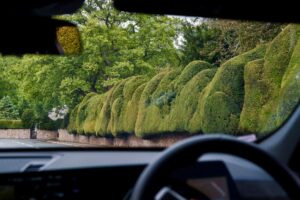
 Brentwood’s residential streets are known for their privacy and curb appeal, but some of the same features that make the neighborhood feel quiet and secluded can also create real safety concerns. Tall hedges, gated properties, and sloped driveways are common throughout the area, and while they offer a sense of separation, they often come at the cost of visibility.
One of the most overlooked risks is the blind driveway. Many homes in Brentwood sit above street level or are set back behind landscaping that blocks a clear view of the road. When a driver begins to pull out, they may not be able to see approaching traffic until the front of their vehicle is already in the street. By that point, any oncoming driver has only a moment to react.
From the perspective of someone already on the road, the experience can feel just as sudden. A car emerging from behind a dense hedge or a gated entrance can appear with very little warning. Even when both drivers are moving cautiously, the limited sight lines can make it difficult to avoid contact, especially on narrower residential streets.
What makes this issue more complex is how frequently these visibility limitations overlap with other conditions. Parked cars often line Brentwood streets, which can further reduce the space available to maneuver. A driver trying to avoid a vehicle pulling out of a driveway may have nowhere to go, increasing the likelihood of a collision. In some cases, the only option is to brake abruptly, which can then create a chain reaction for vehicles following behind.
Pedestrians are also part of this equation, even if they are not always immediately visible. Someone walking along the sidewalk or crossing in front of a driveway may be completely hidden by hedges or walls until the last second. This creates a situation where both the driver exiting the driveway and the pedestrian are relying on limited information, which raises the risk for everyone involved.
The design of these streets adds another layer to consider. Brentwood roads are often quieter than main corridors, which can create a false sense of security. Drivers may assume that traffic will be minimal and approach driveways or intersections with less caution than they would in a busier area. At the same time, other drivers may be moving slightly faster because the road feels open, even if visibility is restricted.
As the day progresses, these risks can shift rather than disappear. Morning and evening hours tend to bring more movement as residents leave and return home, increasing the number of vehicles entering and exiting driveways. During these periods, the chances of two drivers encountering each other at the wrong moment become much higher.
Lighting conditions can also play a role. In the evening, shadows from trees and structures can make it even harder to see beyond hedges or walls. What might already be a limited line of sight during the day becomes even more restricted, reducing the time available to react.
Because these accidents often happen at lower speeds, they can be easy to dismiss at first. However, even low speed collisions can result in injuries, particularly when pedestrians are involved or when the impact catches someone off guard. Damage to vehicles and surrounding property can also add to the overall impact of the incident.
Reducing risk in these situations requires a more deliberate approach. Drivers exiting driveways should ease forward slowly and take the time to check for movement from multiple angles. On the other side, drivers traveling through residential streets should remain aware that a vehicle could emerge at any moment, even if the road appears clear.
When a crash does occur, the question of responsibility is not always straightforward. Visibility limitations, driver behavior, and the specific layout of the property can all factor into what happened and why.
Kamelia Jalilvand works with clients who have been involved in residential collisions where visibility played a key role. She understands that these accidents are often shaped by the environment just as much as the people involved. By taking a closer look at every detail, she helps clients better understand their situation and move forward with the support they need.